
Introduction
What is Shinta Mani Mustang?
Perched at 2,800 meters in the remote Jomsom valley of Mustang, Nepal, Shinta Mani Mustang is a 29-suite luxury retreat designed by celebrated architect Bill Bensley, in partnership with Sherpa Hospitality Group. Nestled on the hillside above the frontier town of Jomsom, it offers an unforgettable, all-inclusive journey of cultural exploration and spiritual growth set against a Himalayan backdrop.
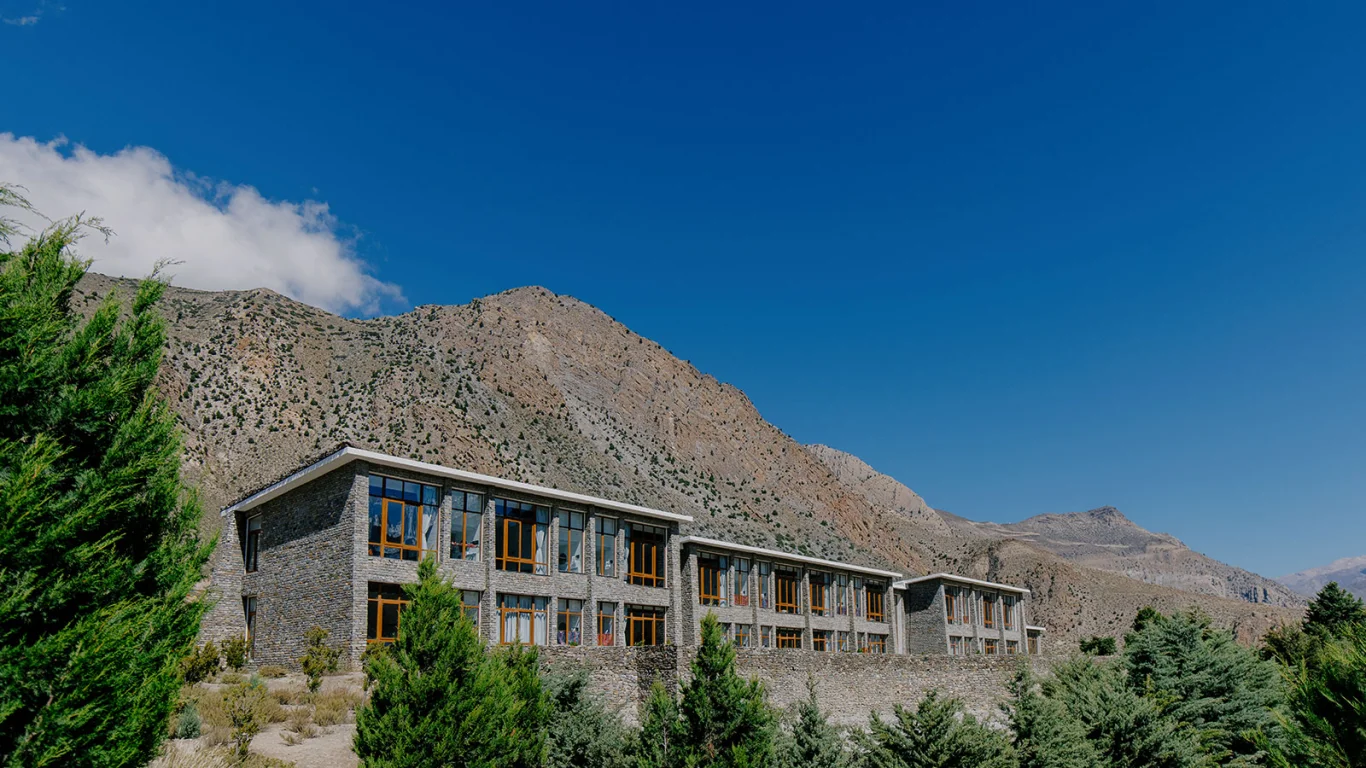
Built of locally sourced stone, slate, and wood, with interiors reflecting local flavor and texture alongside Bensley’s signature flair, the resort sits beneath the Nilgiri mountains, with striking views at every turn. The property is the result of a partnership between renowned Nepali hospitality family Sherpa Hospitality Group, Bill Bensley’s design studio, and hospitality consultant Jason M. Friedman — the same team behind Cambodia’s celebrated Shinta Mani Wild and Shinta Mani Angkor.
Why everyone is talking about it
Shinta Mani Mustang has been on a rapid ascent since opening in 2023. It was named #6 on Robb Report’s “50 Greatest Luxury Hotels on Earth” as recently as last year, and picked up recognition in global “Best of the Best” and “50 Best Luxury Hotels in the World” lists in 2024, before being named Best Luxury Adventure Hotel in 2025. Now, it’s claimed the top global spot — a milestone that’s putting a once-overlooked corner of the Himalayas firmly on the world’s luxury travel map.
World’s No. 1 Luxury Hotel recognition
Shinta Mani Mustang has been ranked the world’s No. 1 hotel in Robb Report’s 50 Greatest Luxury Hotels on Earth 2026, selected by the publication’s panel of 24 Travel Masters — leading luxury travel advisers who curate journeys for high-end travellers. It surpassed renowned properties in Rwanda, Scotland, Japan, India, Italy, the United Kingdom, and France to claim the top spot, with Rwanda’s Singita Kwitonda, Scotland’s Hope Lodge, Japan’s Park Hyatt Tokyo, and India’s Shakti Prana rounding out the top five. In its citation, Robb Report described the property as a “palace of fantasy” offering “breathtaking views” and “the ultimate retreat for the body, mind, and spirit.”
Why luxury travelers should visit
For travelers seeking more than another five-star city hotel, Shinta Mani Mustang offers something rarer: full immersion in one of the last preserved Himalayan cultures on earth. Guests wake up to floor-to-ceiling views of the 7,000-meter, snow-capped Nilgiri range, relax amid carved wood furniture and Tibet-inspired art, and rest under hand-woven blankets. The all-inclusive stay is built around a five-night program combining cultural insight, spiritual connection, and scenic adventure, fully bespoke to each guest.
Highlights include visits to the 800-year-old Bon Buddhist village of Lubra and traditional healing therapies from an on-site Amchi Tibetan doctor, plus horseback riding, archery, wilderness trekking, and personalized wellness treatments designed by an 11th-generation Amchi practitioner. It’s a rare chance to experience genuine five-star luxury in a place that, until very recently, had no luxury infrastructure at all — previously, travelers to this region had lodging options limited to $10-a-night guesthouses or campsites.
Why Shinta Mani Mustang Became the World’s Top Luxury Hotel
Robb Report recognition
Shinta Mani Mustang topped Robb Report’s 2026 list of the 50 Greatest Luxury Hotels on Earth, marking a major milestone for Nepal’s luxury tourism sector. The ranking was selected by Robb Report’s 24 Travel Masters, a panel of leading luxury travel advisers who curate journeys for high-end travellers, with the annual list widely regarded as one of the most prestigious benchmarks in the hospitality industry. The hotel’s climb has been swift: Robb Report had it at #6 on the same list just a year earlier, before it went on to outperform celebrated properties in Rwanda, Scotland, Japan, India, Italy, the UK, and France to claim the No. 1 spot this year.
Sustainable luxury
Sustainability isn’t an add-on at Shinta Mani Mustang — it’s foundational to how the property was designed and built. Architect Bill Bensley has pioneered sustainable hotel design across his portfolio, setting a new precedent in the luxury hospitality industry, and Mustang carries that ethos forward through materials and construction. The resort is built of locally sourced stone, slate, and wood, reflecting local flavor and texture in every detail. Bensley even scoured local antiques shops and “junk yards,” upcycling discarded doors and materials into design features throughout the property.
Unique architecture
Bensley brought warm-toned fabrics and materials that echo the colors of the surrounding landscape, visible from every window of the property. The 29 suites open onto the 7,000-meter, snow-capped peaks of the Nilgiri range through floor-to-ceiling windows, with interiors featuring carved wood furniture, Tibet-inspired art, and hand-woven blankets. Huge fire pits on the outdoor terrace let guests admire the stars in warmth as temperatures drop at altitude, while artwork throughout the property comes from the late Robert Powell, who documented the region’s vernacular architecture in painstaking detail. As Bensley himself put it about the project:
“I have never seen such wildly dramatic landscapes as the mountains and valleys of Mustang, and am thrilled that Shinta Mani can be the first to introduce this Forbidden Kingdom to international adventurers.”
Exclusive experience
Located in the Kali Gandaki Valley of Mustang, the 29-room luxury retreat offers guests a base camp for days of exploration in one of the remotest, most recently opened regions of Nepal. Robb Report highlighted immersive experiences including horse riding, archery, trekking through Mustang’s dramatic landscapes, and visits to the 800-year-old Bon Buddhist village of Lubra — one of the last strongholds of the pre-Buddhist Bon tradition. The five-night, all-inclusive program is fully bespoke, tailored to each guest’s specific interests, whether that’s wilderness trekking, village life immersion, horseback riding through the Mustang Valley, or a private helicopter flight over the Himalaya.
Personalized service
Guests are cared for by the renowned Bensley Butlers, paired here with the deep local knowledge and hospitality spirit of the Sherpa family, who’ve run mountain lodges and trekking operations across Nepal for over three decades. Every detail of the stay — from itinerary to pacing — is shaped around the individual guest rather than a fixed program.
Wellness concept
Wellness is a key element of the experience, built around an individual consultation with the resort’s local Amchi — a traditional Tibetan medicine doctor — who designs a tailor-made program using Himalayan plant- and herb-based therapies. That Amchi, Tsewang Gyurme Gurung, is the 11th-generation recorded practitioner in his lineage of SoRig medicine, drawing on ancestral knowledge passed down through his family for generations. Robb Report singled this out directly, describing the property as “the ultimate retreat for the body, mind and spirit.”
Conservation efforts
The Shinta Mani model — refined earlier at Shinta Mani Wild in Cambodia — ties luxury directly to protecting the places it operates in. In Mustang, guests’ visits to local villages are part of a deliberate effort to ensure tourism benefits surrounding communities and helps preserve centuries-old traditions, including support for practices like Bon Buddhist heritage and traditional Thakali culture. The broader Shinta Mani philosophy treats conservation and community upliftment as core to the guest experience itself, not a side initiative — continuing a model the brand has used to protect endangered wildlife and rainforest habitat at its Cambodia properties.
Where is Shinta Mani Mustang Located?
Exact location
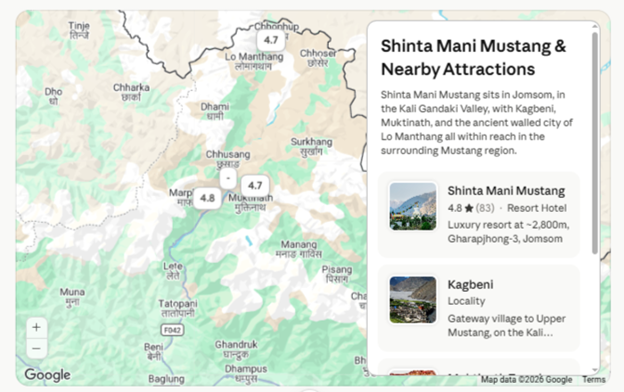
Shinta Mani Mustang sits in Gharapjhong-3, Jomsom, in the Mustang district of Nepal’s Dhaulagiri Zone. The resort is set in the Kali Gandaki Valley — one of the deepest valleys in the world — in Lower Mustang, an area that was largely off-limits to outside visitors until relatively recently.
Elevation
The property sits at 2,800 meters (9,186 feet) above sea level, making it one of the highest-altitude luxury hotels anywhere in the world. That altitude is part of the draw — Mustang’s short season and unpredictable weather has historically deterred the luxury end of the market, which is exactly why so few properties like this exist here.
Map
Nearby attractions
- Jomsom — the frontier town Shinta Mani Mustang overlooks, serving as the main gateway into the region, with its own small airstrip connecting Mustang to Pokhara.
- Kagbeni — a historic riverside village known as the gateway to Upper Mustang, home to the Kag Chode Thupten Samphel Ling Monastery, an important Buddhist site.
- Muktinath — a revered pilgrimage site drawing both Hindu and Buddhist devotees from around the world, famous for its sacred 108 fountains known as Mukti Dhara, where bathing is believed to bring salvation.
- Lo Manthang — the ancient walled capital of the former Kingdom of Lo, deep in Upper Mustang, known for its centuries-old monasteries and mud-brick architecture that feels frozen in time.
- Annapurna Conservation Area — Mustang sits within this protected region, Nepal’s largest conservation area, home to dramatic high-altitude desert landscapes, rare wildlife, and centuries-old Tibetan Buddhist culture preserved by the area’s remoteness.
Other highlights within reach of the resort include the 800-year-old Bon Buddhist village of Lubra, accessible via a hike along the Panda Khola River gorge, and Marpha Village, known for its painted monasteries, stone houses, and apple orchards.
About the Property
Number of villas
Shinta Mani Mustang is a 29-room luxury lodge, managed by its owners, Sherpa Hospitality Group. All 29 keys are designed to feel like an intimate base camp rather than a sprawling resort — the scale is deliberate, keeping the experience personal and immersive in keeping with the remoteness of the setting.
Architectural design
The property was designed by Bill Bensley, with warm-toned fabrics and materials chosen to reflect the colors of the surrounding landscape, visible from every window. Built of locally sourced stone, slate, and wood, the resort is nestled beneath the Nilgiri mountains, designed so that dramatic mountain views are present at every turn. Robb Report described the finished result as a “palace of fantasy” with breathtaking views throughout. Outdoor terraces feature large fire pits, letting guests take in the night sky and thousands of stars while staying warm as temperatures drop at altitude.
Interior
Each suite looks directly onto the 7,000-meter, snow-capped peaks of the Nilgiri range through floor-to-ceiling windows. Interiors are furnished with carved wood pieces and Tibet-inspired art, with guests resting under hand-woven blankets after each day’s adventures. Artwork throughout the property comes from the late Robert Powell, whose detailed drawings captured the region’s vernacular architecture, alongside pieces by Nepali artist Dhwoj Gurung. Textiles are supplied by Altai-Himalaya, a family-run operation that hand-processes and hand-dyes all its yarns in a Kathmandu weaving mill, with output that has also supplied high-end European fashion houses.
Eco-friendly construction
Sustainability runs through the build itself — Bensley scoured local antiques shops and “junk yards,” upcycling discarded doors and salvaged materials into design features rather than sourcing everything new. This reflects Bensley’s broader design philosophy, which has pioneered sustainable hotel construction across his body of work. Local sourcing of stone, slate, and timber also reduces the footprint of construction in a fragile high-altitude environment, while supporting nearby communities and artisans rather than importing materials from outside the region.
Luxury amenities
The property runs as a five-night, all-inclusive experience rather than a traditional room-and-board stay. Amenities include:
- A dedicated wellness spa with individual consultations from an 11th-generation Amchi (Tibetan medicine doctor), offering a bespoke program built on Himalayan plant- and herb-based therapies
- Personal Bensley Butlers guiding daily excursions, from wilderness treks to horseback riding
- Curated dining featuring sustainably foraged and farmed ingredients, alpine picnics, and traditional lunches prepared by local villagers
- Optional add-ons like a private helicopter flight over the Annapurna, Dhaulagiri, and Nilgiri ranges
- Private archery lessons from local Nepalese experts, and multi-day horseback expeditions into Upper Mustang
Room Types at Shinta Mani Mustang: A Guide to Nepal’s World’s Best Luxury Hotel
Tucked into the Kali Gandaki valley at 2,800 meters, between the Annapurna and Dhaulagiri ranges, Shinta Mani Mustang has just been named the world’s No. 1 luxury hotel — and its accommodations are a huge part of why. Designed by legendary architect Bill Bensley, the resort’s 29 suites are laid out like traditional Tibetan homesteads, built from local stone, slate, and wood, and dressed in upcycled fabrics, Robert Powell artwork, and hand-woven Tibetan rugs.
A quick honesty note before we dive in: unlike some luxury resorts, Shinta Mani Mustang doesn’t have separate “villa” structures — every guest stays in one of the property’s suites, organized across three tiers. Here’s how they break down.
Junior Suites — The Entry-Level Escape
Floor area: 36 sq m (387 sq ft) View: Floor-to-ceiling windows facing the Nilgiri mountain range Bed type: Double bed, convertible to twin beds on request, dressed in Irish linens and an embroidered Hermès throw
The Junior Suite is the most compact of the three categories, but “compact” is relative here — you’re still getting a full open-plan bedroom and living area, colorful Bensley-designed furnishings, and Robert Powell’s Mustang-inspired artwork on the walls. The en-suite bathroom comes with a shower and twin sinks.
Amenities included:
- Free Wi-Fi
- Daily refilled minibar (soft drinks, alcohol, and local apple candy)
- Free bottled water
- Tea and coffee-making kit
- Bathrobes and felt slippers
- Organic, locally sourced bath products
Maximum occupancy: 2 guests (3 with an extra bed arrangement, depending on availability)
Best for: First-time visitors and couples who plan to spend most of their time out exploring Mustang rather than in the room.
Premium Suites (Ground Floor & Top Floor Suites) — Elevated Comfort
Floor area: 48 sq m (516 sq ft) View: Panoramic floor-to-ceiling windows onto the Nilgiri range, with top-floor rooms offering slightly more elevated sightlines across the valley Bed type: Double bed (twin setup available on request), Irish linens, embroidered Hermès throw
Step up from the Junior Suite and the extra 12 sq m goes straight into the bathroom experience: a proper bathtub, walk-in shower, twin sinks, and bricks of Himalayan salt built into the design. Some Premium Suites are also wheelchair accessible — worth requesting directly if that matters for your stay.
Luxury facilities:
- Bathtub and separate walk-in rain shower
- Himalayan salt brick detailing
- Daily refilled minibar with local specialties
- Dental kit, bathrobes, felt slippers
- Locally sourced organic bath products
- Access to the SoRig Wellness Center’s two treatment suites, each with a hot plunge pool, steam room, and sauna
Maximum occupancy: 2–3 guests
Best for: Travelers who want a slower, more indulgent pace — think long soaks after a day trekking to Muktinath or Dhumba Lake.
Balcony Suites — The Signature Stay
Floor area: 48 sq m (516 sq ft), plus a private outdoor balcony View: Unobstructed Nilgiri range views from both the suite and the private balcony — this is the room for stargazing over the Himalayas Bed type: Double or king bed, Irish linens, embroidered Hermès throw, hand-woven Tibetan blankets
This is Shinta Mani Mustang’s top category, and the only one with a private balcony — a genuine rarity at this altitude, where most structures are built to withstand ferocious mountain winds rather than open onto them. Interior details mirror the rest of the suites (upcycled Bensley furnishings, Robert Powell artwork, colorful cushions) but the balcony transforms the experience: guests describe it as the best seat in the house for watching the Nilgiri peaks catch the evening light.
Signature features:
- Private balcony overlooking the Nilgiri range
- Bathtub, walk-in shower, twin sinks, Himalayan salt bricks
- All-inclusive dining, drinks, and daily guided excursions bundled into the rate
- Personal wellness consultation with the resort’s 11th-generation Amchi (Tibetan medicine doctor)
- Priority access for spa bookings
Maximum occupancy: 2–3 guests
Best for: Honeymooners, anniversary trips, or anyone who wants the single best view the property has to offer.
A Note on Butler Service and All-Inclusive Perks
Every category at Shinta Mani Mustang is booked on an all-inclusive basis — meals, drinks, a daily guided excursion (trekking, mountain biking, horse riding, or cultural village visits), and a wellness consultation are bundled into the rate regardless of which suite you choose. Dedicated guide and driver support is standard throughout your stay, and heating is provided in every room to offset Mustang’s high-altitude chill, given how cold nights can get at 2,800 meters even in peak season.
Booking Tips
- Suites are limited (29 total across the property), so book several months ahead for peak trekking season (October–November and March–April).
- Ask specifically about accessible Premium Suites if needed — not all rooms in this category are wheelchair accessible.
- Solo travelers should contact the resort or a specialist Nepal travel agent directly for single-occupancy rates, which aren’t always published online.
Room Amenities at Shinta Mani Mustang
Whichever suite category you book, a consistent set of comforts carries through the property — tuned specifically for a remote, high-altitude environment where the usual mountain lodge basics simply won’t cut it.
Bed
King bed in the Ground Floor and Top Floor Suites (Junior Suites have a double, convertible to twins on request), all dressed in Irish linens with an embroidered Hermès throw and memory foam mattresses.
Luxury bathroom
En-suite bathrooms with twin sinks throughout; Premium and Balcony Suites add a soaking bathtub, walk-in rain shower, and Himalayan salt brick detailing. Junior Suites have a shower only.
Heated flooring
A genuinely essential feature at 2,800 meters — every guestroom is fitted with heated floors to offset Mustang’s sharp overnight temperature drops, even in peak trekking season.
Wi-Fi
Complimentary Wi-Fi is available in every suite, a rarity for a property this remote.
Mini bar
A daily refilled minibar stocked with soft drinks, local beer and spirits, and the resort’s own apple candy — all included in the all-inclusive rate.
Coffee & tea
Rooms come with an in-suite tea- and coffee-making kit rather than a full espresso machine; a coffee shop and Aara Bar on property cover anyone craving something more elaborate.
Private balcony
Exclusive to the Balcony Suite category — the resort’s signature room type, with unobstructed private outdoor views of the Nilgiri range.
Air purifier
Not officially listed among in-room features; given Mustang’s dusty, windy high-desert climate, guests with respiratory sensitivities may want to confirm current in-room setups directly with the resort before booking.
Luxury toiletries
Organic, locally sourced bath products, bathrobes, felt slippers, and a dental kit are provided in every room.
Oxygen support
Because of the real risk of altitude sickness at this elevation, Shinta Mani Mustang keeps supplemental oxygen on hand for guest use if needed — worth knowing, though it’s a medical safety measure rather than an in-room fixture, and guests with health concerns should still consult a doctor about altitude medication like Diamox before traveling.Butler service Every guest, regardless of suite category, is assigned a dedicated “Bensley Adventure Butler” for their entire stay — part guide, part concierge, handling everything from daily excursions and laundry to simply keeping the ice bucket full after a day on the trail.
Dining Experience at Shinta Mani Mustang
Food at Shinta Mani Mustang isn’t a side note to the stay — it’s built into the itinerary as its own kind of adventure, and it’s all included in the room rate.
Restaurants: The main dining venue is the 60-seat Nilgiri Restaurant, named for the mountain it looks straight out at through a colorful, art-filled dining room or from the outdoor terrace. For drinks, Aara Bar — named after the local Tibetan/Sherpa liquor — pairs plush leather stools and parquet floors with those same knockout Nilgiri views.
Breakfast: Mornings are unhurried by design and breakfast is served at Nilgiri with the sunrise hitting the Nilgiri range through floor-to-ceiling views, mixing familiar Western options with Nepali staples to fuel a day of trekking, biking, or village visits.
Lunch: Lunch often happens away from the restaurant entirely. Expect alpine picnics set up in some of the most scenic spots along the day’s excursion route, plus traditional lunches prepared by villagers in local kitchens — a direct, hands-on introduction to how Mustang actually eats.
Dinner: Dinner is where the kitchen really shows off. The resort runs a five-night rotating dinner concept, with a different theme each evening: a Silk Road–themed menu pairing Tibetan laphing (spicy cold noodles) with tandoori chicken; a five-course exploration of momo dumplings filled with everything from beets and cheese to chocolate; and menus built around ancient trans-Himalayan trade route recipes.
Wine selection: Aara Bar carries what’s described as one of the region’s largest collections of wine and single malt whiskey, alongside a menu of exclusive house cocktails.
Local Mustang cuisine: Menus lean hard into the region’s Thakali food culture, with input tied to figures like local Thakali chef Kamala Didi. Expect momos, laphing, and dishes built around Mustang staples like apple and apricot — reinterpreted rather than served straight, with the kitchen putting creative spins on traditional recipes rather than just replicating them.
Organic ingredients: The resort sources the majority of its produce locally, foraging and farming for organic, seasonal ingredients, and draws directly from its own four-hectare, 2,000-plus-tree apple and apricot orchard on the property — the source behind dishes and cocktails alike (the Marpha Appletini, made with apple brandy from the neighboring village, is a signature pour).
Private dining: Beyond the restaurant, guests can arrange tailored picnics in scenic outdoor locations as part of their daily excursions, as well as meals hosted in local village kitchens — a more intimate, community-connected alternative to typical resort private dining.
Chef experience: Guests can join a hands-on cooking class led by one of the resort’s chefs, learning to prepare traditional Nepalese dishes against a Himalayan backdrop — and then sitting down to eat what they made.
Wellness Experience at Shinta Mani Mustang
At 2,800 meters, wellness here isn’t an add-on spa day — it’s framed as recovery from real mountain exertion, built around centuries-old Tibetan medicine rather than a generic international spa menu.
Spa: The SoRig Wellness Center is a modern, stylish spa overlooking the Nilgiri range, with private treatment rooms for individuals or couples, steam and sauna facilities, and — in some accounts — a heated plunge pool as part of the treatment suites.
Yoga: Yoga and exercise sessions are offered in the resort’s activity room or on the terrace, typically slotted in around the day’s trekking or excursion schedule rather than run as fixed daily classes.
Meditation: Formal in-house guided meditation isn’t heavily documented, but Mustang itself is built for it — the Lubra excursion ends at cliffside caves once used for centuries as meditation retreats, and several guests describe the spa experience itself, paired with mountain silence, as effectively meditative.
Sound healing: Sound healing isn’t listed as a specific named treatment at Shinta Mani Mustang (it’s a signature offering at its sister property, Shinta Mani Wild, in Cambodia). Guests specifically seeking it should confirm availability directly with the resort before booking.
Massage: Deep-tissue massage is a core offering, positioned as the go-to remedy after a day of trekking, biking, or horseback riding, delivered by highly trained therapists in private treatment rooms.
Traditional Tibetan therapies: This is where Shinta Mani Mustang genuinely stands apart: therapies are rooted in SoRig (Sowa Rigpa), the traditional Tibetan medicine system, and include cupping with copper vessels to relieve muscle tension and improve circulation, along with herbal steam sessions using aromatic, medicinal herbs.
Hot stone treatment: The resort doesn’t advertise a specifically named “hot stone” treatment; instead, its signature soak is a Hot Pool Bath, described as easing muscle tension, improving circulation, and reducing stress after a day at altitude. Guests wanting an actual hot stone massage should ask the spa team directly, as offerings can be tailored per guest.
Wellness consultation: Every guest’s spa journey begins with a one-on-one consultation with Tsewang Gyurme Gurung, an 11th-generation Amchi (Tibetan medicine doctor), or his practitioner. He assesses overall physical and mental wellbeing and prescribes a personalized treatment plan — a specific herbal steam bouquet, a poultice for sore muscles, particular massage oils — drawing on generations of ancestral SoRig knowledge rather than a standard spa questionnaire.
Activities Included During Your Stay
Part of what makes Shinta Mani Mustang the world’s newly-crowned No. 1 luxury hotel isn’t just the architecture — it’s the immersive, all-inclusive experiences woven into every stay. With a minimum five-night stay built into the itinerary, guests have real time to slow down and go deep into Mustang’s culture and landscape.
Village Walks & Ancient Monasteries — Guided walks lead through the Kali Gandaki Valley to Lubra, an roughly 800-year-old Bon Buddhist village that remains one of the last of its kind, offering a rare window into a spiritual tradition older than Tibetan Buddhism itself.
Horse Riding & Archery — Traditional Mustangi pursuits let guests explore the dramatic high-desert terrain the way locals have for centuries.
Cultural Immersion & Cooking Class — Thakali culinary traditions come alive through hands-on classes, connecting guests to the region’s food heritage and local producers.
Meditation & Wellness — An on-site Amchi (a Tibetan medicine doctor from an 11-generation lineage) offers personal health evaluations and traditional healing therapies, alongside meditation sessions rooted in the region’s Buddhist heritage.
Photography — Golden-hour light on Mt. Nilgiri and the surrounding peaks makes early mornings a highlight — many guests rate it among the most photogenic stays in the Himalayas.
Helicopter Sightseeing — For sweeping aerial views of the Annapurna and Dhaulagiri ranges, and easy access into this once-restricted “Forbidden Kingdom.”
Private Guide — Every guest is paired with a dedicated guide who curates outings around personal interests, pace, and fitness level.
Things to Do Near Shinta Mani Mustang
Beyond the resort itself, Lower and Upper Mustang unfold as one of the most compelling — and least crowded — regions in the Himalayas. Here’s what’s worth venturing out for:
Muktinath Temple
One of the most sacred pilgrimage sites in both Hinduism and Buddhism, perched at over 3,700 meters with 108 water spouts said to cleanse sins. The drive up alone delivers some of the valley’s best views.
Lo Manthang
The walled former royal capital of the Kingdom of Lo, only opened to outside visitors in 1992. Its narrow lanes, whitewashed palace, and centuries-old monasteries make it the cultural heart of Upper Mustang.
Chhoser Cave (Jhong Cave)
A multi-story man-made cave complex carved into the cliffside, believed to be centuries old and still not fully explained by archaeologists — one of Mustang’s most mysterious sites.
Sky Caves of Mustang
Thousands of ancient man-made caves dot the cliffs above the Kali Gandaki, some containing 2,000–3,000-year-old human remains, art, and manuscripts — among the greatest unsolved archaeological puzzles in the Himalayas.
Kagbeni
A medieval village at the gateway to Upper Mustang, where mud-brick alleyways, chortens, and an old monastery sit right at the edge of the restricted zone.
Nilgiri Viewpoint
Front-row views of the 7,000+ meter Nilgiri massif, especially striking at sunrise when the peak turns gold.
Ancient Monasteries
Beyond Lo Manthang, smaller gompas scattered through the valley (like those in Marpha and Tsarang) hold centuries-old murals and Buddhist artifacts largely untouched by modern tourism.
Apple Orchards
Marpha, Mustang’s “apple capital,” is famous for its orchards, apple brandy, and dried apple products — a mellow, scenic contrast to the high-desert cliffs and caves elsewhere in the region.
Best Time to Visit Shinta Mani Mustang
Mustang sits in the rain shadow of the Annapurna and Dhaulagiri ranges, so its weather rhythms are different from the rest of Nepal. That said, the resort itself closes each year during July and August as a precaution against unpredictable road conditions between Pokhara and Jomsom — so realistically, your options fall into four windows.
Spring (March–May): Widely considered the best season to visit. Days are warm, skies are clear, and mountain trails come carpeted in rhododendrons, wild irises, and poppies. If your timing lines up, you may catch Upper Mustang’s three-day Tiji Festival, where monks perform elaborate masked dances.
Advantage: Stable weather, peak visibility of the peaks, and vivid wildflower landscapes.
Summer (June): The warmest stretch of the year, with daytime temperatures climbing to around 32°C (90°F) and pleasantly cool nights near 21°C (70°F). Lower Mustang’s terraced fields turn lush as farmers harvest potato, wheat, and barley.
Advantage: Warm, comfortable temperatures and green, fertile valley scenery — a contrast to Mustang’s usual high-desert look.
Monsoon (July–August): This is when the resort closes to guests. Rains bring life to the land, but they also make the roads between Jomsom and Pokhara unpredictable and prone to landslides, so travel isn’t recommended during this window.
Advantage: None for visitors — this is the resort’s off-season for safety reasons.
Autumn (September–November): Nepal’s peak travel season, and for good reason. Days are pleasant and warm (around 8–10°C), nights are crisp, and skies stay crystal clear with virtually no rain or snow. Late summer into early autumn also brings the four-day Yarthung Festival, featuring horse races, feasting, and dancing to mark the end of summer.
Advantage: The clearest mountain views of the year, ideal trekking conditions, and vibrant local festivals.
Winter (December–February): Daytime temperatures hover between 0–10°C (32–50°F), with snow dusting Jomsom and the surrounding peaks. Despite the cold, winter days are often clear and sunny, and with far fewer tourists around, it’s an appealing choice for travelers seeking a quieter, more intimate experience.
Advantage: Dramatic snow-capped scenery, fewer crowds, and deeper access to authentic local life.
How to Reach Shinta Mani Mustang?
Getting to Shinta Mani Mustang is part of the adventure itself — this is one of the most remote luxury properties in the world, tucked into the Kali Gandaki Valley at around 2,700 meters. Here’s how travelers typically make the journey.
Kathmandu → Pokhara: The journey begins with a short domestic flight from Kathmandu to Pokhara, taking roughly 25 minutes. Pokhara serves as the main gateway city to the Annapurna and Mustang regions, and most guests use it as a transit stop rather than a destination.
Pokhara → Jomsom: From Pokhara, a second short domestic flight covers the roughly 20-minute hop to Jomsom, the closest airstrip to the resort. This leg is scenic but weather-dependent — mountain flights here are known for early-morning departures, since winds pick up later in the day.
Helicopter Option: For travelers who want to skip the connections entirely, a direct helicopter transfer from Kathmandu to Shinta Mani Mustang is available, taking around 90 minutes door-to-door. It’s the fastest and most comfortable route, and also the most weather-reliable alternative when fixed-wing flights are delayed.
Road Option: An overland route also connects Pokhara to Jomsom, following the Kali Gandaki Valley. It’s a longer, bumpier alternative to flying, but offers dramatic valley scenery along the way.
Private Jeep: For guests who prefer not to fly, a private jeep can be arranged for the Pokhara–Jomsom stretch. It takes considerably longer than a flight but allows for stops in villages along the route.
Domestic Flights: Domestic flights remain the most common way to reach Jomsom, though they’re notoriously weather-sensitive — delays and cancellations aren’t unusual, especially outside the clear-sky spring and autumn seasons.
Walking Option: From Jomsom airstrip, the final approach to the resort involves a short walk/transfer into the valley — a gentle, scenic way to arrive after the flights, offering first views of the surrounding peaks before checking in.
Travel Duration: All told, door-to-door travel from Kathmandu typically takes half a day to a full day via flights (Kathmandu–Pokhara–Jomsom), or as little as 90 minutes via direct helicopter.Road Conditions Roads in and around Jomsom, and especially the Pokhara–Jomsom route, become unpredictable during monsoon season (July–August) due to landslide risk — one of the key reasons the resort closes during those months. Outside monsoon, road conditions are more stable, though still rugged compared to lowland Nepal.
Do You Need Restricted Area Permits?
This is one of the most misunderstood parts of planning a Mustang trip — so let’s clear it up properly.
The Short Answer Shinta Mani Mustang sits in Lower Mustang (Jomsom), which is not part of the restricted zone. That means you do not need the expensive Upper Mustang Restricted Area Permit (RAP) to stay at the resort. What you do need is the Annapurna Conservation Area Permit (ACAP) and, in some cases, a TIMS card — both standard, inexpensive permits required for the broader Annapurna region.
Restricted Area Permit (RAP) — Only for Upper Mustang
The RAP is a separate, tightly controlled permit required only if you’re heading north of Kagbeni into Upper Mustang — toward Lo Manthang, the Sky Caves, or the old walled kingdom. As of 2026, it’s priced at $50 USD per person, per day spent inside the restricted zone, and it can only be issued through a registered Nepali trekking agency — never independently. If your itinerary at Shinta Mani Mustang stays within Lower Mustang, this permit simply doesn’t apply to you.
Annapurna Conservation Area Permit (ACAP)
Since the entire Mustang region — Upper and Lower — falls inside the Annapurna Conservation Area, every foreign visitor needs an ACAP, priced at roughly $25–30 USD. This one is straightforward to obtain and isn’t subject to the same restrictions as the RAP.
When Permits Are Required
- ACAP: Required for any foreign traveler entering Mustang, including Lower Mustang and the resort itself.
- TIMS Card: Only required if you’re arriving by road (via Pokhara) rather than flying directly into Jomsom.
- RAP: Only required if your journey extends into Upper Mustang, beyond Kagbeni.
Do Hotel Guests Still Need Permits?
Yes — technically every foreign visitor needs the ACAP (and TIMS, if arriving overland) to legally enter the region. The good news: Shinta Mani Mustang handles all of this for you. Permits are built directly into the room rate and arranged by the resort in advance, so guests don’t need to visit an immigration office, fill out paperwork, or coordinate anything themselves — it’s simply taken care of before arrival.
Why Independent Travelers Can’t Simply Walk Into Upper Mustang
Upper Mustang is a strictly regulated border zone abutting Tibet, and Nepal treats it differently from almost anywhere else in the country. The Restricted Area Permit can only be processed through a licensed trekking agency — never by an individual applying alone — and it comes with a mandatory guide requirement, checkpoint monitoring at entry points like Kagbeni, and steep penalties (fines up to $5,000 and deportation) for anyone caught inside without the correct paperwork.
This system exists to protect the region’s fragile Tibetan Buddhist culture and limit the environmental and social impact of unregulated tourism on a population of only a few thousand people. So while Lower Mustang (and Shinta Mani Mustang itself) is easily and legally accessible, venturing into Upper Mustang independently — without an agency, guide, and RAP — simply isn’t possible.
How Much Does It Cost?
Shinta Mani Mustang operates on an all-inclusive model with a mandatory five-night minimum stay, so understanding the true cost means looking beyond just the nightly room rate.
Room Price Rates vary by suite category, all based on double occupancy:
- Junior Suite (36 sqm): ~$1,890/night
- Ground Floor Suite (48 sqm): ~$1,990/night
- Top Floor Suite (48 sqm): ~$2,090/night
- Balcony Suite (48 sqm): ~$2,285/night
An extra bed adds roughly $900–$1,100/night for an adult, or around $500/night for a child aged 0–12.
Luxury Packages: Most guests book the standard five-night all-inclusive program, with total package pricing starting around $10,000 USD for two people. This typically bundles suite accommodation, all meals and drinks, guided excursions, spa access, and transfers into one fixed cost.
Seasonal Rates: Room rates stay largely consistent year-round, though rooms can be harder to secure during peak spring (March–May) and autumn (September–November) travel windows. The resort closes entirely in July and August for monsoon season, so no rates apply then.
Helicopter Cost: Helicopter transfers are not included in the base package and are booked separately — expect this to add a significant amount depending on your Kathmandu-to-Mustang routing, given the roughly 90-minute direct flight time.
Permit Cost: Since the resort sits in Lower Mustang, only modest permits apply:
- ACAP (Annapurna Conservation Area Permit): ~$30/person
- TIMS Card: ~$20/person (only required if traveling overland; not needed if flying directly)
Both are arranged and included by the hotel — no extra cost or paperwork on your end.
Transportation Cost: Domestic flights (Kathmandu–Pokhara–Jomsom) or road transfers are generally arranged separately from the room package, though round-trip vehicle transfers between Jomsom airport and the resort itself are included.
Guide Cost: A personal Bensley Adventure Butler/guide is included in every stay at no extra charge, covering all private guided excursions in the Lower Mustang area.
Meals: All meals and beverages — including alcoholic and non-alcoholic drinks, both on-property and during excursions — are fully included in the room rate.
Taxes: Government taxes, luxury taxes, and gratuities are built into the quoted nightly rate, so there are no surprise add-ons at checkout.
Estimated Total Vacation Budget For a couple doing the standard five-night program:
- Package cost: ~$10,000+ USD (accommodation, meals, guiding, wellness, permits, transfers included)
- Plus flights/helicopter to reach Jomsom: variable, often several hundred to a few thousand dollars depending on route
- Realistic total: roughly $10,500–$14,000+ USD for two people, depending on suite category and whether you helicopter in versus flying commercial
How to Book Shinta Mani Mustang?
Given the resort’s remote location and five-night minimum stay, booking usually happens through one of a few channels — each with its own advantages.
Book Directly: The most straightforward route is booking directly through the resort’s own website or reservations team via email/phone. This works well if you already know your exact dates and suite preference and want to deal with the property directly for any custom requests.
Luxury Travel Agency: Many travelers book through established luxury travel specialists who can bundle Shinta Mani Mustang into a broader Nepal itinerary — pairing it with stays in Kathmandu, Pokhara, or an Everest scenic flight, and handling logistics like helicopter transfers and permits on your behalf.
Tour Operator: This is where working with a trusted, Nepal-based tour operator makes the biggest difference. Visit View Nepal Trek is our company, and we can manage your entire Shinta Mani Mustang booking end-to-end — from securing your suite and arranging permits (ACAP/TIMS), to coordinating flights or helicopter transfers, airport pickups, and any pre- or post-stay itinerary in Kathmandu or Pokhara. Booking through a local operator means someone on the ground is handling weather-dependent flight changes, permit paperwork, and last-minute logistics, so your trip runs smoothly from arrival to departure.
Advance Booking: Because the property has only 29 suites and a mandatory five-night stay, availability is limited relative to typical hotels. Booking several months in advance — especially for peak spring (March–May) and autumn (September–November) travel — is strongly recommended. Reach out to us at Visit View Nepal Trek early to lock in your preferred dates and suite category.
Cancellation Policy: Cancellation terms vary by booking channel and rate type, so always confirm the specific policy at the time of booking. Luxury properties like this typically apply stricter cancellation windows than standard hotels, given the bespoke, all-inclusive nature of the program. When you book through us, we’ll walk you through the exact terms before you commit.
Deposit: Most bookings require a partial deposit (commonly around 50%) to secure your reservation, with the remaining balance due a set number of days before arrival (often 30 days out). Exact deposit terms depend on the booking channel, and we can confirm the current policy for your travel dates.
Peak Season Availability: Spring and autumn — the clearest, most popular travel windows — book out fastest given the limited suite count. If you’re set on those seasons, aim to reserve as early as possible; shoulder months like June or winter tend to offer more flexibility.
Ready to plan your stay? Get in touch with Visit View Nepal Trek — we’ll handle the logistics so you can focus on the experience.
Sample Luxury Itinerary
Here’s how a typical eight-day escape to Shinta Mani Mustang might unfold, blending Kathmandu’s culture, Pokhara’s lakeside calm, and five immersive nights in Mustang.
Day 1 — Kathmandu
Arrive into Kathmandu and settle into a luxury hotel in the city. Spend the day exploring UNESCO World Heritage sites like Boudhanath Stupa or Pashupatinath, and ease into Nepal’s pace with a welcome dinner featuring traditional Nepali cuisine.
Day 2 — Pokhara
A short domestic flight brings you to Pokhara, gateway to the Annapurna range. Spend the day lakeside at Phewa Lake, with mountain views of Machhapuchhre (Fishtail) in the distance — a relaxed transition day before heading into the high Himalayas.
Day 3 — Fly to Mustang
An early flight (or helicopter transfer) takes you from Pokhara to Jomsom, followed by a short scenic drive or walk to Shinta Mani Mustang. Arrive to a warm welcome, check into your suite, and spend the afternoon settling in — perhaps with a spa treatment or a short acclimatization walk to nearby Thini village, capped off with sunset views over the Himalayas.
Days 4–6 — Luxury Stay
Three full days immersed in the all-inclusive Shinta Mani experience, guided by your personal Adventure Butler. Highlights typically include a trek through Marpha’s apple orchards and traditional stone villages, a wilderness hike through the Jomsom Valley with panoramic mountain views, wellness sessions with the resort’s on-site Amchi doctor, and time to enjoy horse riding, archery, or mountain biking at your own pace.
Day 7 — Explore Villages
Venture out to the villages of Jharkot, Jhong, and Kagbeni — the gateway to Upper Mustang — with an optional visit to Muktinath, one of the most sacred pilgrimage sites in the Himalayas. Round out the day with an excursion to Lubra, the roughly 800-year-old Bon Buddhist village, before returning to the resort for your final night.
Day 8 — Return
Depart Shinta Mani Mustang with a scenic flight or drive back to Pokhara, connecting onward to Kathmandu for your international departure — or extending your trip with additional nights, depending on your itinerary.
Note: All activities within the Mustang portion (Days 3–7) are included in Shinta Mani Mustang’s all-inclusive package — meals, guiding, transfers, and permits are covered, with only helicopter transfers priced separately.
Why Book Through Visit View Nepal Trek?
Planning a trip to Shinta Mani Mustang involves more moving parts than a typical hotel booking — remote flights, permits, seasonal closures, and weather-dependent logistics all need to line up perfectly. That’s where working with a dedicated local operator makes all the difference. Here’s what you get when you book with Visit View Nepal Trek:
Personalized Trip Planning: Every traveler is different, so we build your Mustang itinerary around your pace, interests, and travel style — whether you want a relaxed five-night stay or a fuller Nepal journey woven around it.
Permit Arrangement: We handle your ACAP and TIMS permits from start to finish, so you never have to navigate paperwork or immigration offices yourself.
Flight Booking: From your Kathmandu–Pokhara–Jomsom connections to backup options during weather delays, we manage your domestic flight bookings so your itinerary stays on track.
Hotel Reservation: We secure your Shinta Mani Mustang suite directly, along with any hotels needed in Kathmandu or Pokhara before and after your stay.
Helicopter Charter: For travelers who want the fastest, most scenic route into Mustang, we arrange private helicopter charters and transfers as an add-on to your itinerary.
Luxury Transportation: From private airport transfers to ground transport between cities, we ensure every leg of your journey matches the standard of the destination.
Professional Guides: Our guides bring deep local knowledge of Mustang’s culture, geography, and history — going beyond what’s included in the resort’s own guided program when you extend into surrounding regions.
Emergency Support: Should weather delays, flight cancellations, or unexpected issues arise, our team is on the ground and ready to adjust your plans in real time.
Local Expertise: With years of experience organizing trips throughout Nepal, we know the region’s hidden details — from the best seasonal windows to lesser-known villages worth a detour.
Customized Itinerary: No two trips look the same. We tailor your journey length, pace, and add-ons (Upper Mustang extensions, Everest scenic flights, cultural tours) to fit exactly what you’re looking for.
Competitive Pricing: We work directly with trusted partners and the resort to offer transparent, competitive pricing — with no hidden fees along the way.
24/7 Assistance: From your first inquiry to your final departure, our team is available around the clock to answer questions and handle anything that comes up mid-trip.
Cultural Experiences: Beyond the resort itself, we can curate deeper cultural encounters — village visits, monastery tours, and local festivals — depending on your travel dates.
Airport Transfers: Every leg of your journey, from international arrival in Kathmandu to your final departure, includes smooth, private transfers.
Flexible Travel Plans: Mustang’s weather can be unpredictable, so we build flexibility into your itinerary from the start — helping you adapt smoothly if flights shift or plans change.
Ready to start planning? Reach out to Visit View Nepal Trek and let us take care of the logistics, so all you have to do is enjoy the journey.
Benefits You’ll Receive When Booking With Us
✔ Personalized itinerary
✔ Guaranteed hotel reservation
✔ Restricted area permits arranged
✔ Domestic flight booking
✔ Luxury private transportation
✔ Helicopter booking assistance
✔ Airport pickup and drop
✔ Professional local guides
✔ Emergency support
✔ Local cultural experiences
✔ No hidden costs
✔ Fast communication
✔ Flexible itinerary
✔ Expert travel consultation
✔ Pre-trip briefing
✔ Responsible tourism practices
Frequently Asked Questions
1. Where is Shinta Mani Mustang located?
Shinta Mani Mustang sits in Gharapjhong-3, Jomsom, in the Lower Mustang region of Nepal, at an elevation of approximately 2,800 meters (9,186 ft) in the Kali Gandaki Valley.
2. Do I need a restricted area permit to stay there?
No. Since the resort is in Lower Mustang, you only need an ACAP (Annapurna Conservation Area Permit) and possibly a TIMS card. The Upper Mustang Restricted Area Permit is only required if you venture beyond Kagbeni into Upper Mustang.
3. Is Shinta Mani Mustang really the world’s best luxury hotel?
Yes — in 2026, it was ranked No. 1 on Robb Report’s “50 Greatest Luxury Hotels on Earth” list, selected by a panel of 24 leading luxury travel advisers.
4. How many rooms does the resort have?
The property has 29 suites, designed by architect Bill Bensley.
5. Is there a minimum stay requirement?
Yes, a minimum of five consecutive nights is required to fully experience the resort’s program and excursions.
6. What’s included in the room rate?
Meals and drinks, private guided excursions, wellness treatments, transfers, permits, gratuities, and taxes are all included. Helicopter flights are the main exception.
7. How do I get to Shinta Mani Mustang?
Most travelers fly Kathmandu–Pokhara–Jomsom via domestic flights, then transfer to the resort. A direct helicopter option from Kathmandu (around 90 minutes) is also available, as is a longer overland route via Pokhara.
8. When is the best time to visit?
Spring (March–May) and autumn (September–November) offer the clearest skies and most stable weather, making them the most popular seasons.
9. Is the resort open year-round?
No — it closes annually in July and August during monsoon season due to unpredictable road conditions.
10. How much does a typical stay cost?
Package pricing for two people typically starts around $10,000 USD for the five-night program, with total trip costs (including flights or helicopter transfers) often landing between $10,500–$14,000+ USD.
11. What activities are included during the stay?
Village walks, horse riding, archery, cultural excursions, cooking classes, meditation, and visits to ancient monasteries are all part of the guided program, led by a personal Adventure Butler.
12. Can I visit Upper Mustang from the resort?
Yes, as an optional add-on. Trips to Lo Manthang or other Upper Mustang sites require the separate Restricted Area Permit and additional cost.
13. Is the resort suitable for families with children?
Yes, extra beds for children are available at a reduced rate, and activities can be tailored to different fitness levels and ages.
14. What’s the altitude, and is altitude sickness a concern?
The resort sits at roughly 2,800 meters, with some excursions reaching higher elevations. Most guests acclimate without issue, but those sensitive to altitude should consult a doctor before traveling.
15. Who designed the resort?
Renowned architect Bill Bensley designed the property, in partnership with Nepali architect Prabal Thapa and Sherpa Hospitality Group.
16. Can I book directly, or do I need a travel agent?
Both options exist — you can book directly with the resort, or work with a specialist tour operator like Visit View Nepal Trek, who can handle permits, flights, and full itinerary planning on your behalf.
17. What’s the cancellation policy?
Cancellation terms vary by booking channel and rate type, so it’s best to confirm specifics at the time of booking — luxury properties like this typically have stricter policies than standard hotels.
18. Is Wi-Fi available at the resort?
Yes, Wi-Fi is available throughout the property, though connectivity in this remote region can occasionally be less reliable than in cities.
19. What kind of food is served?
Meals highlight Thakali and Nepali-Tibetan cuisine using locally sourced, organic ingredients, alongside international options.
20. How far in advance should I book?
Given the resort’s limited 29 suites and five-night minimum, booking several months ahead — especially for peak spring and autumn dates — is strongly recommended.
Travel Tips
A trip to Shinta Mani Mustang is remote, high-altitude, and unlike a typical luxury hotel stay — a bit of preparation goes a long way toward making it seamless.
Packing List: Pack light but smart: layered clothing, a reusable water bottle, a good camera, basic toiletries, any personal medications, sunglasses, sunscreen, and a headlamp for early starts. Since the resort is remote, bring everything you’ll need — options for last-minute purchases are limited once you’re in Mustang.
Clothing: Mustang’s high-desert climate means big temperature swings between sun and shade, and between day and night. Layering is essential: breathable base layers, a warm mid-layer (fleece or down), a windproof/waterproof outer shell, sturdy walking shoes or light hiking boots, a warm hat, gloves, and a buff or scarf for dust and wind protection.
Cash: Mustang is remote, and ATMs are scarce to nonexistent once you’re outside Pokhara. Carry enough Nepalese Rupees (and some USD) in cash for tips, souvenirs, and small purchases in villages — major hotels in Kathmandu and Pokhara accept cards, but don’t count on that once you’re in the mountains.
Altitude: The resort sits at around 2,800 meters, with some excursions climbing higher. Most guests acclimate without issue, but take it easy on arrival, stay hydrated, and mention any relevant health conditions to your guide or the resort’s on-site Amchi doctor. If you’re prone to altitude sensitivity, consult your doctor before traveling.
Photography: Golden hour — early morning and late afternoon — delivers the best light on Mount Nilgiri and the surrounding peaks, so plan for early starts on clear days. A wide-angle lens is useful for landscapes, and a zoom lens helps for village and cultural shots. Always ask permission before photographing local people, monasteries, or religious ceremonies.
Weather: Expect dry, cold conditions year-round, with strong winds that typically pick up in the afternoon. Spring and autumn bring the clearest skies; winter is cold but often sunny; summer is warm during the day but cool at night; and monsoon (July–August) brings unpredictable roads, which is why the resort closes during those months.
Electricity: Nepal runs on 230V with Type C, D, and M plug sockets. Power in remote areas like Mustang can be less consistent than in cities, so bring a universal adapter and consider a portable power bank for charging devices between excursions.
Internet: Wi-Fi is available at the resort, but connectivity in this remote region can occasionally be slower or less reliable than what you’re used to at home — worth setting expectations accordingly, especially if you need to stay connected for work.
Drone Rules: Nepal’s drone regulations are strict, and Mustang is a particularly sensitive, restricted area. Flying a drone here legally requires CAAN registration, customs declaration on arrival in Kathmandu, and additional authorization for restricted/conservation zones — a process that can take several weeks and is best handled through a registered local agency well before your trip. Flying without the correct permits risks confiscation and significant fines, so don’t assume you can fly casually once you arrive.
Health Advice: Consult a doctor before your trip regarding altitude, any relevant vaccinations, and travel insurance that covers high-altitude regions and medical evacuation. Pack a basic personal first-aid kit, stay hydrated throughout your stay, and take advantage of the resort’s on-site Amchi doctor consultation as part of your wellness program.
Responsible Tourism: Mustang is a small, culturally distinct region where tourism directly affects fragile communities and traditions. Respect local customs, dress modestly when visiting monasteries and villages, ask before photographing people, support local artisans and producers where possible, and follow your guide’s lead on cultural etiquette — small gestures of respect go a long way in a region still adjusting to outside visitors.
Final Thoughts
Shinta Mani Mustang’s rise to the world’s No. 1 luxury hotel isn’t a fluke — it’s the result of a rare combination: Bill Bensley’s masterful design working in harmony with the landscape rather than against it, Sherpa Hospitality’s decades of on-the-ground expertise, and a genuine commitment to weaving local culture, wellness, and community into every part of the guest experience. From the on-site Amchi doctor practicing an 11-generation healing tradition, to guided visits to 800-year-old Bon Buddhist villages, this is a hotel that earns its accolades by being deeply, authentically rooted in where it stands.
And Mustang itself is unlike anywhere else on earth. This is a high-desert kingdom that remained closed to outsiders until just a few decades ago — a place of ancient sky caves, walled royal cities, ochre cliffs, and Tibetan Buddhist culture that has survived largely untouched by the modern world. Few destinations offer this level of remoteness paired with this level of luxury; fewer still let you experience one of Nepal’s last “forbidden kingdoms” while sleeping in a suite with floor-to-ceiling views of the Nilgiri range.
But a journey this remote and layered — with its permits, weather-dependent flights, seasonal closures, and logistics — is not one to piece together alone. Getting the timing, transportation, and paperwork right is what separates a smooth, unforgettable trip from a stressful one.
That’s exactly where we come in. Visit View Nepal Trek is ready to design your custom luxury itinerary to Shinta Mani Mustang — handling everything from permit arrangement and flight or helicopter bookings, to airport transfers, guides, and every detail of your journey through Nepal. Whether you’re dreaming of five nights in the Himalayas or a full multi-region luxury escape, contact Visit View Nepal Trek today and let us turn your trip to the world’s best luxury hotel into a seamless, unforgettable reality.
Hotel Fact Box
| Detail | Information |
| Location | Gharapjhong-3, Jomsom, Mustang, Nepal (Kali Gandaki Valley) |
| Elevation | ~2,800 meters (9,186 ft) |
| Number of Suites | 29 |
| Room Categories | Junior Suite, Ground Floor Suite, Top Floor Suite, Balcony Suite |
| Dining | Nilgiri Restaurant (60-seat, indoor/outdoor); Aara Bar (cocktails, local & imported spirits) |
| Nearest Airport | Jomsom Airport (domestic flights via Pokhara) |
| Alternate Access | Direct helicopter transfer from Kathmandu (~90 minutes) |
| Minimum Stay | 5 consecutive nights |
| Seasonal Closure | July–August (monsoon season) |
| Permit Requirements | ACAP + TIMS (included in room rate); Upper Mustang RAP only if extending beyond Kagbeni |
| Designer | Bill Bensley, with Prabal Thapa Architects |
| Operator | Sherpa Hospitality Group |
| Notable Recognition | World’s No. 1 Luxury Hotel, Robb Report “50 Greatest Luxury Hotels on Earth” 2026 |
Note: Exact check-in/check-out times are set by the resort and confirmed at time of booking — contact Visit View Nepal Trek for current details.
Pricing Table
| Room Category | Size | Rate (per night, double occupancy) | Extra Adult Bed | Extra Child Bed (0–12) |
| Junior Suite | 36 sqm | ~$1,890 | ~$900 | ~$500 |
| Ground Floor Suite | 48 sqm | ~$1,990 | ~$950 | ~$500 |
| Top Floor Suite | 48 sqm | ~$2,090 | ~$1,000 | ~$500 |
| Balcony Suite | 48 sqm | ~$2,285 | ~$1,100 | ~$500 |
Package Inclusions (all room categories): All meals & beverages (alcoholic and non-alcoholic, on- and off-property) · Private guided excursions with a personal Adventure Butler · Unlimited spa/wellness treatments · Amchi doctor consultation · Round-trip transfers to/from Jomsom airport · ACAP & TIMS permits · Wi-Fi · Daily laundry · All taxes and gratuities
Not Included: Helicopter transfers · Upper Mustang excursions (RAP-required) · Optional add-ons (mountain biking, extended trekking, sound bath sessions)
Typical 5-night package starts around $10,000 USD for two guests. Rates are subject to change — contact Visit View Nepal Trek for current pricing and availability.
Shinta Mani Mustang vs. Other Luxury Lodges in Nepal
| Property | Region | Style | Price Range | Best For |
| Shinta Mani Mustang | Lower Mustang (2,800m) | All-inclusive remote luxury lodge | ~$1,890–$2,285/night (all-inclusive) | Immersive, once-in-a-lifetime Himalayan adventure with deep cultural access |
| Dwarika’s Hotel | Kathmandu | Heritage boutique hotel | ~$300–$500/night | City-based cultural immersion, Newari architecture |
| The Pavilions Himalayas | Pokhara foothills | Eco-luxury villas | ~$400–$600/night | Relaxed wellness retreat with farm-to-table dining |
| Tiger Mountain Pokhara Lodge | Above Pokhara | Boutique eco-lodge | Mid-range luxury | Panoramic Annapurna views, sustainable tourism |
| Tiger Tops Karnali/Tharu Lodge | Chitwan/Bardia | Wildlife lodge | Mid-to-high range | Wildlife safari experiences, jungle immersion |
| Dwarika’s Resort Dhulikhel | Dhulikhel | Wellness retreat | Mid-to-high range | Spa-focused relaxation near Kathmandu |
What sets Shinta Mani Mustang apart: Unlike Kathmandu- or Pokhara-based luxury hotels, it’s the only ultra-luxury property located deep within a formerly restricted Himalayan region, offering an all-inclusive model that bundles guiding, permits, and cultural experiences most other lodges charge for separately.
Pros and Cons of Staying at Shinta Mani Mustang
Pros
- World’s No. 1-ranked luxury hotel (Robb Report, 2026)
- Truly all-inclusive — meals, guiding, permits, transfers, and wellness bundled into one rate
- Unmatched access to a culturally rich, historically restricted region
- Personalized guiding via a dedicated Adventure Butler for every guest
- Architecturally striking, sustainably built property with locally sourced materials
- On-site traditional Amchi doctor and wellness program found nowhere else in Nepal
Cons
- High price point relative to other Nepal luxury properties
- Mandatory 5-night minimum stay limits flexibility for shorter trips
- Remote location means weather-dependent flights and potential delays
- Seasonal closure in July–August removes two months from the calendar
- Helicopter transfers and Upper Mustang excursions cost extra
- Limited connectivity/internet reliability compared to city hotels
Route Map
Kathmandu → Pokhara → Jomsom → Shinta Mani Mustang, the full journey from Kathmandu’s Tribhuvan International Airport through Pokhara to Jomsom Airport and on to Shinta Mani Mustang itself.
Please Note: A service charge will be added to your total booking amount once you confirm your reservation with Visit View Nepal Trek. This covers the planning, coordination, and support provided throughout your journey — including permit processing, flight and transfer arrangements, and 24/7 assistance during your trip. Final pricing, including applicable service charges, will be confirmed at the time of booking.