
After years of leading trekkers through the Himalayas, one question comes up more than almost any other: should you trek in Nepal with a group, or go it alone? There’s no single right answer — it depends on your budget, your comfort with uncertainty, and what kind of experience you’re after. Here’s what I’ve learned from the trail that can help you decide.
Quick answer: Solo trekking works best for independent, budget-conscious travelers on open (non-restricted) routes like Poon Hill or Langtang Valley. Group trekking is the safer, more supported choice for higher, more remote, or legally restricted routes like Everest Base Camp, Manaslu Circuit, or Annapurna Circuit — and it’s what most visitors to Nepal end up choosing.
Trekking draws a huge share of visitors to Nepal each year — government data from 2021 shows that roughly 11% of all foreign arrivals come specifically to hike or trek. With trails ranging from gentle village walks to high-altitude passes above 5,000 meters, Nepal genuinely has a route for every kind of traveler. The real question is how you want to walk it.
What Do “Solo Trekking” and “Group Trekking” Actually Mean?
Solo trekking means covering the trail entirely on your own — no guide, no porter, no travel companions. It suits people who genuinely enjoy their own company and want total control over their days. Back in 2019, around 46,000 of the 170,000 trekkers who visited Nepal chose this route, so it’s far from a fringe choice.
Group trekking means hiring a licensed guide, a porter, or traveling with a set of friends along a fixed itinerary. Given how unpredictable Himalayan trails can be — sudden weather shifts, altitude issues, remote terrain — most first-time visitors to Nepal lean toward this safer, more social option.
Permits and Guide Requirements You Should Know First
This is the detail that catches a lot of independent trekkers off guard: not every trail in Nepal is legally open to solo hikers.
- Restricted areas — including Manaslu, Upper Mustang, Upper Dolpo, and Kanchenjunga — require a licensed guide by law, regardless of your experience level.
- Popular routes like Everest Base Camp and Annapurna Circuit don’t require a guide by law, but do require a Sagarmatha National Park permit or ACAP (Annapurna Conservation Area Permit), along with a TIMS card (Trekkers’ Information Management System) in most cases.
- Open trails such as Poon Hill and Langtang Valley remain the most accessible for solo trekkers, needing only the relevant conservation area permit — no mandatory guide.
Rules do shift from time to time, so it’s worth confirming current requirements with the Nepal Tourism Board or a local trekking agency before you finalize your route.
Need Help? / Call Us
+977-9845548583 or Chat with us on WhatsApp
Ask a Question?
Solo Trekking: Advantages and Trade-Offs
Why trekkers choose to go alone
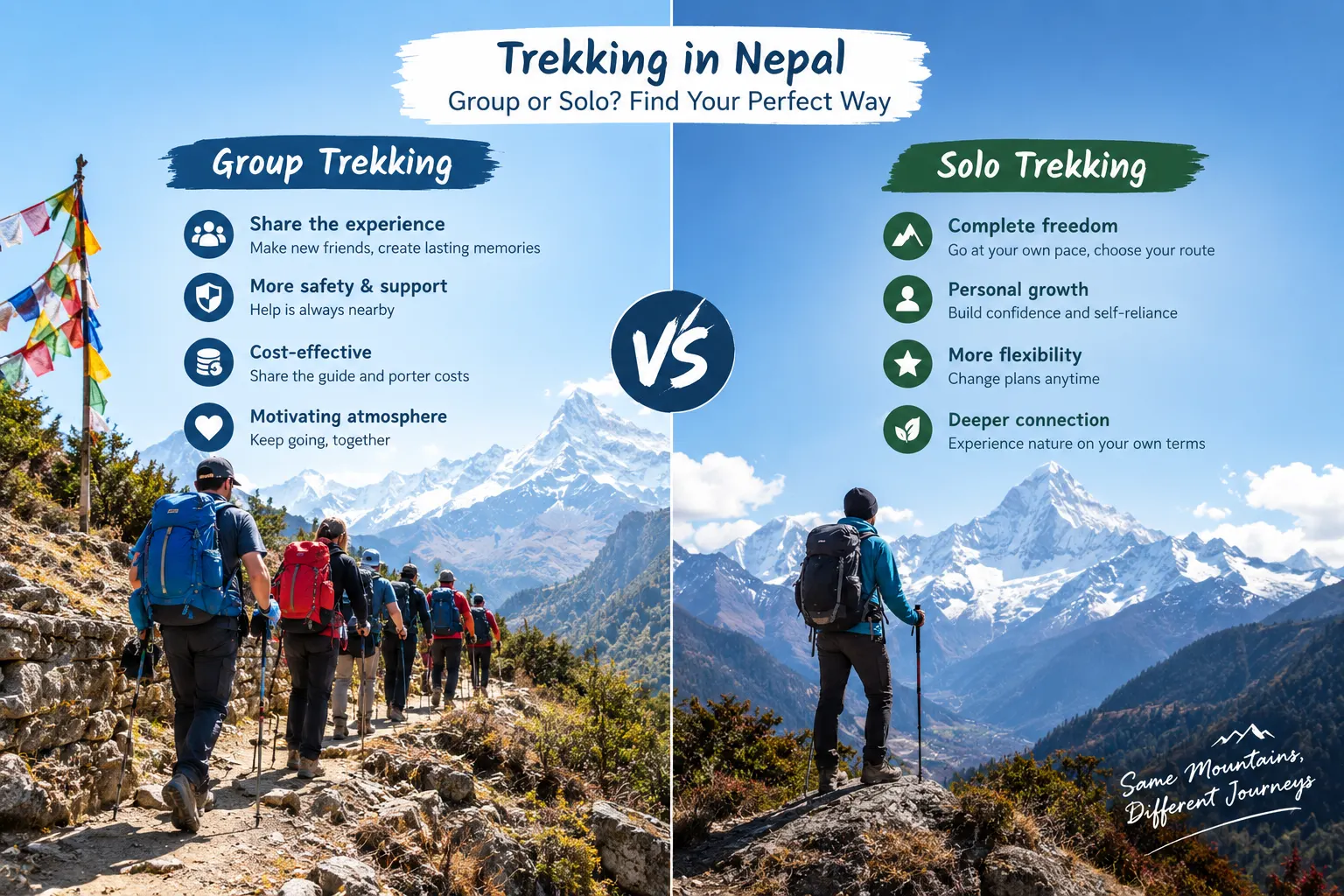
- Full budget control. You decide where to eat and sleep each night, which makes it easier to trek on a tighter budget.
- Freedom over your itinerary. Want to stay an extra day in a village or extend your route on a whim? Nobody to consult but yourself.
- A genuinely peaceful experience. For introverts, solo trekking in Nepal can feel like moving meditation — just you, the trail, and the mountains.
- Better for creative work. Writers and photographers often find that solitude sharpens focus and deepens the quality of their work on the trail.
Where solo trekking gets risky
- Limited backup in emergencies. Altitude sickness, an ankle injury, or a sudden landslide during the off-season are far harder to manage without anyone nearby.
- Loneliness can catch you off guard. Even confirmed introverts sometimes find isolation harder than expected several days into a trek.
- Language barriers. Without a guide, communicating in remote villages where English isn’t widely spoken can slow you down or cause confusion.
- No support for logistics. Arranging permits, transport, and last-minute lodging changes falls entirely on you.
Group Trekking: Advantages and Trade-Offs
Why most visitors still choose a group
- A safety net when it matters most. A guide or fellow trekkers can step in for gear issues, physical strain, or emotional low points.
- Shared costs. Food, accommodation, and transport expenses split across the group, often making it more affordable per person than expected.
- Route knowledge and risk management. Licensed guides know which sections to avoid in poor weather, how to pace acclimatization properly, and what to do if altitude sickness sets in.
- Built-in companionship. Long days of walking, tough climbs, and shared meals tend to forge fast friendships — many trekkers stay in touch with their trekking crew long after the trip ends.
The downsides of trekking with others
- Less spontaneity. Fixed itineraries leave little room for side trips or detours that solo trekkers can take freely.
- Group dynamics can wear thin. Larger groups sometimes feel chaotic, and personality clashes can dampen the overall experience.
- Higher overall cost. Guide fees, porter wages, and emergency provisions like travel insurance or evacuation coverage add up, and everything typically needs to be booked in advance.
Solo vs Group Trekking at a Glance
| Factor | Solo Trekking | Group Trekking |
| Cost | Lower, fully self-controlled | Higher, but shared across the group |
| Safety net | Minimal — no backup nearby | Strong — guide and companions on hand |
| Itinerary flexibility | Full freedom to change plans | Fixed schedule, less room to deviate |
| Best for | Experienced, independent trekkers | Beginners and higher-altitude routes |
| Permits/guide required | Only on open routes | Guide often included or mandatory |
| Social experience | Solitary, reflective | Shared memories, built-in companionship |
Best Trails in Nepal for Solo Trekkers
Not every route in Nepal allows independent trekking — some restricted areas legally require a licensed guide. But a few classic trails remain open and well-suited to solo travelers:
Langtang Valley Trek
- Duration: 7–9 days
- Difficulty: Moderate
- Max elevation: Around 3,870 m (Kyanjin Ri viewpoint reaches higher for those who add it on)
A short drive from Kathmandu, this trek takes you through yak pastures, Tamang villages, and up to Kyanjin Gompa beneath Langtang Lirung. It’s a quieter alternative to the more crowded Everest and Annapurna regions, with well-marked trails that make it manageable without a guide.
Poon Hill Trek
- Duration: 4–5 days
- Difficulty: Easy to moderate
- Max elevation: Around 3,210 m (Poon Hill viewpoint)
This is one of the most beginner-friendly treks in Nepal — and a favorite recommendation for first-time solo hikers. The trail winds through Gurung villages and rhododendron forests before rewarding you with sunrise views over the Annapurna and Dhaulagiri ranges.
Annapurna Base Camp Trek
- Duration: 7–10 days
- Difficulty: Moderate to challenging
- Max elevation: 4,130 m
Another route commonly attempted solo, though trekkers should check current permit requirements before setting out, since regulations in Nepal’s trekking regions are updated periodically.
Need Help? / Call Us
+977-9845548583 or Chat with us on WhatsApp
Ask a Question?
Best Season to Trek in Nepal
Regardless of whether you go solo or with a group, timing matters more than almost anything else:
- Spring (March–May): Warm days, blooming rhododendrons, clear mountain views.
- Autumn (September–November): The most popular season — stable weather and the clearest skies of the year.
- Winter (December–February): Quiet trails but cold temperatures and snow at higher altitudes.
- Summer/Monsoon (June–August): Wet, slippery trails and limited visibility — generally best avoided except in rain-shadow areas like Upper Mustang.
Group vs Solo Trekking: Which Should Beginners Choose?
Honestly, there’s no universal winner — both approaches have trekkers who’ve had great trips and others who’ve struggled. It comes down to matching the option to your priorities:
- Choose solo trekking if you value independence, want tight control over your budget, and don’t mind handling logistics and unexpected situations yourself. Langtang Valley, Poon Hill, and Annapurna Base Camp are solid starting points.
- Choose group trekking if safety, shared costs, and built-in support matter more to you than flexibility. Routes like Everest Base Camp and Manaslu Circuit — both more demanding and remote — are far better suited to guided groups.
In my experience, most trekkers ultimately go with a group, mainly because it makes decision-making easier, keeps everyone safer on unpredictable terrain, and turns a challenging trek into a shared memory rather than a solitary test of endurance.
Frequently Asked Questions
1) Is solo trekking legal in Nepal?
Yes, on open trails such as Poon Hill and Langtang Valley. Restricted regions like Manaslu, Upper Mustang, and Kanchenjunga require a licensed guide by law.
2) Do I need a guide for Everest Base Camp?
Not legally, but most trekkers hire one anyway for safety, navigation, and help with acclimatization at altitude.
3) Is group trekking more expensive than solo trekking?
Per person, it can be similar or even cheaper than expected, since guide and porter costs, plus accommodation, are shared across the group.
4) What’s the safest option for a first-time trekker in Nepal?
Group trekking on a well-established route, paired with proper acclimatization days, is the safer choice for most beginners.
What permits do I need for trekking in Nepal?
This depends on the region — common ones include the TIMS card, Sagarmatha National Park permit (Everest region), and ACAP (Annapurna region). Restricted areas require additional special permits.
Whichever path you choose, make sure your permits, insurance, and season timing are sorted well before you land in Kathmandu.